You step out of Yeouinaru Station Exit 2 expecting the effortless riverside picnic you saw in Korean dramas: steaming instant noodles cooked on a riverside machine, crispy fried chicken delivered straight to your blanket, and a breezy shade tent overlooking the water.
Ten minutes later, your picnic turns into a logistical nightmare. You place a regular convenience store cup noodle onto the induction heater, and within thirty seconds the polyethylene base melts, triggers a piercing overheat alarm, and spills boiling soup across the counter. Outside on the grass, a municipal enforcement officer taps on your rented pop-up tent because it is 7:15 PM and two sides are zipped shut—informing you that violations of the River Act carry an administrative fine of up to 1,000,000 KRW. Worse yet, you cannot order fried chicken because Korean delivery apps reject foreign credit cards without a domestic 010 phone number, and couriers are strictly banned from entering the park lawns.
Below is the clinical, regulation-verified field manual to Seoul’s Han River Parks—covering exact barcode induction cooker mechanics, legal shade tent operating windows, numbered Baedal Delivery Zones, and Banpo Bridge fountain logistics.
VERIFIED FIELD AUDIT (2026 EDITION): All municipal regulations, tent operation hours, and enforcement penalties in this guide are cross-checked against the official Seoul Future Hangang Headquarters (미래한강본부) operational ordinances and on-site convenience store terminal specs at Yeouido, Banpo, Ttukseom, and Mangwon Hangang Parks.
The Bottom-Line Han River Park Comparison Matrix
| Park Name | Exact Subway Access | Primary Attraction | Baedal Zones & Food Logistics | Crowd & Tent Density |
|---|---|---|---|---|
| Yeouido Hangang Park | Line 5 Yeouinaru Station, Exit 2 & Exit 3 (1 min walk) | Waterfront plaza, Eland Cruise terminal, mat rental alley | Baedal Zones 1, 2 & 3; highest concentration of GS25/CU ramen machines | Very High on weekends; arrive before 11:30 AM for tent zones |
| Banpo Hangang Park | Line 3/7/9 Express Bus Terminal, Exit 8-1 or 8-2 (10 min walk via underground tunnel) | Banpo Bridge Moonlight Rainbow Fountain & Sebitseom floating islands | Baedal Zones 1 & 2 near Sebitseom parking lot; on-site chicken booths | Peak congestion 18:30–21:30 around the fountain amphitheater |
| Ttukseom Hangang Park | Line 7 Jayang (Ttukseom Hangang Park) Station, Exit 2 & Exit 3 | J-Bug cultural complex, paddleboarding, drone light shows | Baedal Zones 1 & 2; 7-Eleven and GS25 directly beneath Exit 2 | Moderate-High; spacious designated shade tent lawns east of the bridge |
| Mangwon Hangang Park | Line 6 Mangwon Station, Exit 1 + Mapo 09 green mini-bus (or 15 min walk) | Starbucks floating river branch, Battleship Park, sunset views | Dedicated Baedal Zone; many visitors carry takeout from Mangwon Market | Relaxed, local neighborhood vibe; easier afternoon lawn space |
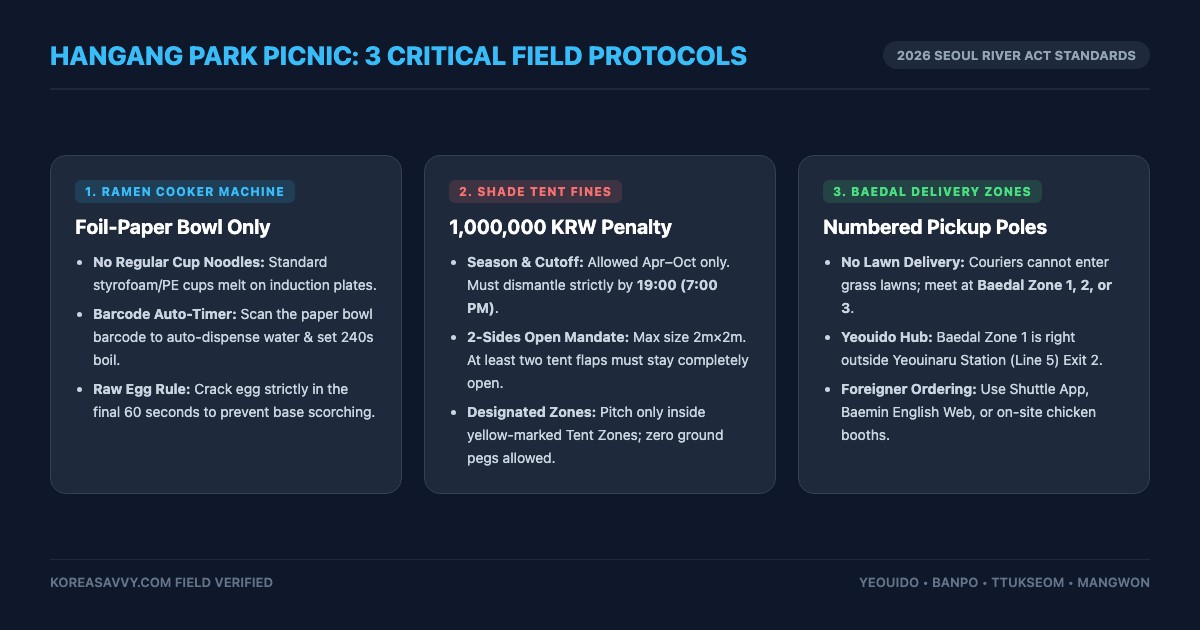
1. Instant Ramen Induction Machine Mechanics: Why Standard Cup Noodles Melt
The iconic “Han River Ramen” experience relies on high-powered commercial induction hotplates (most commonly the Cooker / Haansong models) installed outside riverside CU, GS25, 7-Eleven, and Emart24 convenience stores. Unlike domestic electric kettles that simply dispense hot water, these machines use an electromagnetic induction coil embedded in the base plate to bring water to a rolling boil directly inside a disposable container.
The single most common mistake foreign visitors make is grabbing a standard plastic or styrofoam cup noodle off the shelf and placing it on the induction plate. Standard cup noodles lack a metallic induction layer; placing them on the cooker either fails to trigger the magnetic sensor or melts the polyethylene bottom coating if the plate is residual-hot from the previous user. Even worse, attempting to tear open a standard cup noodle and pour it into a normal paper bowl will scorch the paper within seconds.
The Exact 5-Step Foil-Bowl Execution Protocol
- Skip the Cup Noodle Aisle: Walk straight to the dry square/round packet ramen shelves (such as Shin Ramyun, Jin Ramen, Chapagetti, or Buldak Bokkeum Myeon, priced at 1,000 to 1,800 KRW).
- Request the Dedicated Induction Bowl at Checkout: At the register, tell the cashier you are using the outdoor ramen machine. You must purchase a specialized aluminum-foil-lined paper bowl (labeled Jeukseok-joriyong Yonggi, priced at 1,200 to 1,500 KRW). The bottom interior of this bowl is laminated with a conductive metallic foil sheet that reacts with the induction coil, while the outer paper wall insulates your hands. A bundled packet ramen + foil bowl set typically costs 3,500 to 4,500 KRW total.
- Dry Assembly Before Going Outside: Unwrap your ramen brick and place the dry noodles, soup powder, and dehydrated vegetable flakes into the foil-lined bowl before placing it on the machine. Never turn on the induction plate with an empty bowl—it will immediately burn the dry foil layer and trigger an E1 or E2 overheating error.
- Scan the Barcode on the Bowl Rim: Every authentic Han River foil bowl has a specific printed barcode on its side or rim (distinguishing between soup ramen and stir-fry/jaJang ramen). Hold that barcode 5 cm beneath the red laser scanner on the front of the cooker. The machine will beep, automatically dispense the exact milliliter volume of water (typically 420–450 ml for soup noodles), and start a calibrated 240-second (4-minute) to 270-second induction boil cycle.
- The 60-Second Raw Egg Rule: Convenience store counters sell single raw eggs in plastic capsules for 600 to 800 KRW. Do not crack the raw egg into the bowl before starting the machine. If the heavy egg white sinks onto the bare aluminum foil bottom before the water reaches a full convective boil, it bonds to the metal, chars black, and blocks heat transfer. Wait until the digital countdown timer has 60 to 90 seconds remaining, gently lift the center of the boiling noodles with your chopsticks, and drop the egg on top of the noodle nest so it poaches cleanly.
2. The 1,000,000 KRW Shade Tent Fine Trap: Seoul River Act Compliance
Walking out of Yeouinaru Station Exit 2, you will be approached by dozens of street vendors and rental shops offering pop-up shade tents, picnic mats, folding tables, and fairy lights for 15,000 to 25,000 KRW. While renting a tent is completely legal, rental shops rarely explain the strict municipal rules enforced by patrolling inspectors from the Seoul Future Hangang Headquarters.
MUNICIPAL ENFORCEMENT WARNING: Under the Seoul Metropolitan River Act ordinances, pitching a tent outside designated zones, closing more than two tent flaps, or leaving a tent up past 7:00 PM results in an immediate on-site administrative fine starting at 1,000,000 KRW (~$730 USD).
The 5 Non-Negotiable Shade Tent Rules
- Seasonal Operating Calendar: Personal and rented shade tents are permitted strictly from April 1 through October 31. From November 1 to March 31, all tents and windbreaks are banned across all 11 Han River Parks (picnic mats without roofs remain permitted year-round).
- Strict Daily Time Window (09:00 AM – 07:00 PM): Tents may only be erected between 09:00 AM and 07:00 PM (19:00). Beginning at 18:45, park loudspeakers broadcast dismantling warnings in Korean and English, and municipal officers walk the lawns at 19:00 sharp. Even if you want to stay until 10:00 PM to eat chicken, you must collapse the tent at 19:00 and remain only on your flat picnic mat.
- The “Two Sides Open” Visibility Rule: To prevent illicit camping and ensure public safety, at least two sides of your tent must remain completely tied or zipped open at all times so the interior is visible from the outside. Zipping a 4-sided pop-up tent completely closed is legally classified as unauthorized camping.
- Maximum Footprint (2m × 2m) & Zero Ground Stakes: Tents cannot exceed 2 meters by 2 meters (4 square meters). Furthermore, driving metal or plastic stakes/pegs into the grass is strictly prohibited because high-voltage lighting cables and automated irrigation pipes run just beneath the turf. Secure your tent corners using your backpack, shoes, or water bottles inside the tent.
- Designated Yellow Boundary Zones Only: You cannot pitch a tent directly on the concrete waterfront steps or on narrow cycling corridors. Tents are restricted to marked “Shade Tent Permitted Zones” (Geuneulmak Seolchi Heoyong Guyeok) delineated by yellow boundary lines or wooden posts on the main lawns.
3. Ordering Fried Chicken Without a Korean Phone Number: Baedal Delivery Zones
Before 2019, motorbike couriers rode directly onto park walkways, handing out paper flyers and shouting order numbers. To stop pedestrian collisions and flyer litter, the Seoul Metropolitan Government banned delivery motorbikes from entering park interiors and established numbered Baedal Delivery Zones (배달존)—tall, illuminated signposts placed at the perimeter where park pathways meet vehicle parking lots.
For foreign tourists, ordering food to a Han River Park presents two distinct hurdles: finding the exact Baedal Zone pole and bypassing the Korean identity-verification wall on domestic delivery apps.
3 Field-Tested Ordering Methods for Foreign Tourists
- Method A — Baemin (Baedal Minjok) Official Foreigner Flow: South Korea’s largest delivery app, Baemin, now allows non-resident tourists to check out using international Visa, Mastercard, and JCB credit cards without Korean ARC residency verification (specifically under its non-member / global payment flow). Set your map pin directly onto Yeouido Baedal Zone 1, 2, or 3 (or Banpo Baedal Zone 1/2), and write the exact pole number in the delivery memo.
- Method B — Shuttle Delivery App (100% English UI): If Baemin rejects your foreign card’s 3D-Secure verification, download Shuttle Delivery. It operates entirely in English, accepts international credit cards and PayPal, and allows you to chat with English-speaking customer support who will coordinate with the courier to meet you at your exact Baedal Zone signpost.
- Method C — On-Site Riverside Chicken Booths (Zero App Required): If you do not have data roaming or want zero delivery wait, both Yeouido Hangang Park (along the waterfront deck between Exits 2 and 3) and Banpo Hangang Park (inside the Sebitseom and floating store complexes) operate official licensed fried chicken kiosks, such as BHC Chicken, BBQ Olive Chicken, and Puradak. You can tap any foreign credit card, Apple Pay (at supported terminals), or T-Money/WOWPASS card directly at the counter and carry the box 50 meters to your picnic mat.
How the Baedal Zone Pickup Handoff Works
When you place an app order, never stay seated on your lawn mat waiting for a phone call—especially if you are using a data-only eSIM that cannot receive Korean voice calls. Walk to your designated Baedal Zone signpost (e.g., Yeouido Baedal Zone 2 near Mapo Bridge south end) 5 minutes before the estimated arrival time shown in the app tracker. Couriers pull up on scooters, call out the last 4 digits of the order phone number or the restaurant brand name + menu item, and hand over the food in under 15 seconds.
4. Banpo Bridge Moonlight Rainbow Fountain Schedule & Tunnel Access
If your primary goal is watching the Guinness World Record Banpo Bridge Moonlight Rainbow Fountain—where 380 nozzles shoot 190 tons of river water per minute illuminated by LED lights synchronized to K-Pop and classical music—you must target Banpo Hangang Park rather than Yeouido.
- Exact Subway Pedestrian Route: Take Subway Line 3, 7, or 9 to Express Bus Terminal Station and exit via Exit 8-1 or Exit 8-2. Walk straight for 250 meters along the apartment complex sidewalk until you reach a wide concrete pedestrian underpass tunnel that cuts safely beneath the Olympic-daero highway directly onto the Banpo waterfront plaza.
- Official Operating Season & Showtimes (20 Minutes Per Show):
- April – June & September – October: 12:00 PM (daytime water show), 7:30 PM, 8:00 PM, 8:30 PM, and 9:00 PM.
- July – August (Peak Summer Schedule): 12:00 PM, 7:30 PM, 8:00 PM, 8:30 PM, 9:00 PM, and an extra late show at 9:30 PM.
- Weather Cutoff: Fountain operations are automatically suspended during heavy rain, high wind speeds exceeding 7 m/s, or post-monsoon river flooding.
Han River Picnic Budget & Fine Compliance Auditor
2026 Municipal Rates & Rules
5. Actionable IF-THEN Execution Protocols for Your Visit
- IF the convenience store queue at the Yeouinaru waterfront barge is longer than 25 people: Do not wait 40 minutes in line by the river. Walk 120 meters back up the steps to the street-level convenience stores directly outside Yeouinaru Station Exit 1 or Exit 2, which operate identical rows of induction ramen cookers with a fraction of the foot traffic.
- IF the induction ramen machine flashes an “E1” or “E2” error code: Lift the foil bowl slightly, wipe any spilled water droplets off the black glass induction ring with a tissue, verify that dry noodles did not get trapped under the foil base, and re-scan the bowl barcode to resume heating.
- IF you are renting a picnic mat or tent from an Exit 2 vendor: Always photograph the condition of the wooden folding table and tent poles before walking into the park, and verify the shop’s exact closing time (most rental shops near Yeouinaru require equipment return by 10:00 PM or 11:00 PM to reclaim your ID or cash deposit).
- IF you plan to cycle along the river after eating: Read our clinical breakdown of the Seoul Public Bike Ddareungi Foreigner Rental, QR App, and Riding Rules to avoid the 50,000 KRW Gyeonggi-do boundary penalty and temporary-lock overtime charges.
- IF you prefer picking up authentic Korean street snacks before heading to Mangwon Hangang Park: Check our Seoul Traditional Street Food Markets: Gwangjang, Mangwon, and Tongin Comparison to grab 1,500 KRW stuffed chili peppers and dakgangjeong at Mangwon Market on your way to the river.